Health systems & multi‑location programs
One program across every facility
For pharmacy leadership, finance and compliance teams at health systems and multi‑location operators. One governance model, local execution and one place to see it all.
Hospital
Pharmacy
Clinic
Long‑term care
Surgery center
Physician office
The challenges we hear
Returns get harder with every site you add
What pharmacy and finance leaders tell us when their network outgrows a site‑by‑site approach.
Fragmented vendors per site
Different partners, contracts and processes at each facility, and no single picture of the program.
Inconsistent documentation
Records kept differently from site to site, which makes audits slower and riskier than they should be.
Controlled‑substance risk
Form 222 workflows, counts and chain of custody that depend on who is on shift.
Missed manufacturer credits
Product that drifts outside its returnable window because nobody owns the review.
Staff burden on pharmacists
Clinical time spent inventorying expired stock instead of caring for patients.
Program model
How multi‑location returns work
Central governance, local execution: one partner and one set of standards for the network, with each facility running self‑service or rep visits and every return visible in one portal.
One governance model
One partner, one process and one set of standards for the whole network.
Site‑level execution
Each facility runs self‑service or rep visits, at the cadence it needs.
Central visibility
Every account, every return and every status, in one portal.
Consolidated payment
The complete amount for each return on one check, within 90 days.
Multi‑location programs
One program, every facility type
Hospitals, outpatient pharmacies, infusion centers, clinics and long‑term care each have a different volume, controlled‑substance profile and staffing model. The program adapts to each one without splitting in two.
What flexes per site
Service model: self‑service or rep visits
Pickup cadence, aligned to facility routines
Controlled‑substance handling and C2 Kits
Disposal categories the site generates
The accounts each user can access
What stays the same
One governance model and one partner
One portal and one statement format
Manufacturer‑policy evaluation on every item
Licensing and compliance documentation
One check per return, within 90 days
Stakeholder value
Built for everyone who signs off on it
Control and standard workflows
One way of working across every site, with the flexibility each facility needs and a clear view of what is happening where.
The same process and portal at every location
Self‑service or rep service chosen per facility
Program reviews on a regular cadence

Recovered credit you can follow
Credit is pursued item by item against manufacturer policies, and every payment is traceable back to the return it came from.
Statements for every past and current return
Payment dates and amounts by return
One check for each return, within 90 days

Documentation that holds up
Controlled substances, hazardous waste and state licensing handled by a licensed, NABP‑accredited reverse distributor.
DEA Form 222 and C2 Kits for controlled items
Waste classified under RCRA and EPA Subpart P
Licensing and registration documents on request

Less time on returns
Staff initiate returns as soon as Rx's expire, or hand the whole job to a rep, and get back to patients.
Scan or enter items in minutes
A rep can take care of it A to Z
Direct access to our support team

Reporting & analytics
Every return, every site, one place
We live by values that support our customers and their return value. Transparency is one of them.
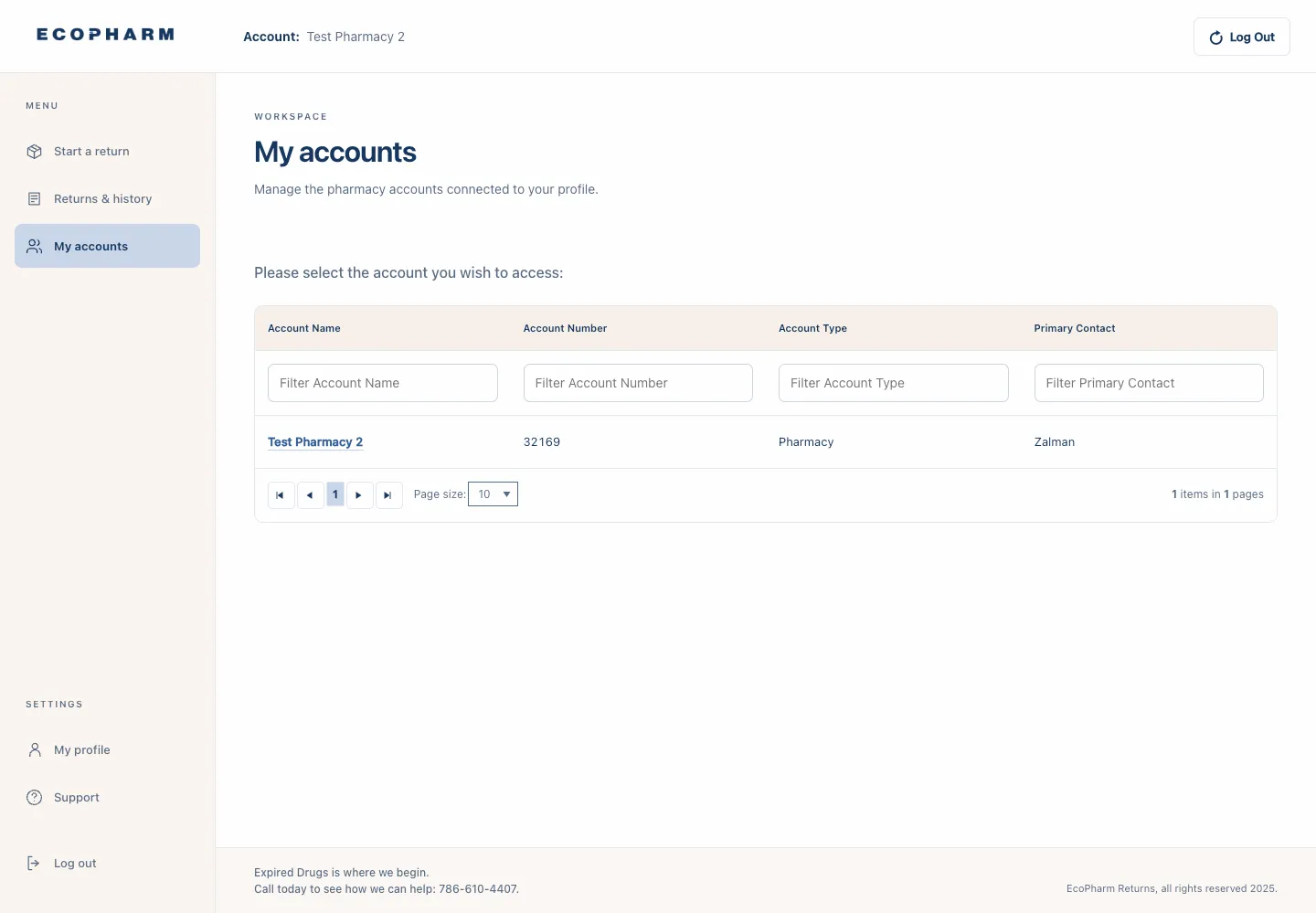
Account view
Every pharmacy account connected to a profile, by name, number and type.
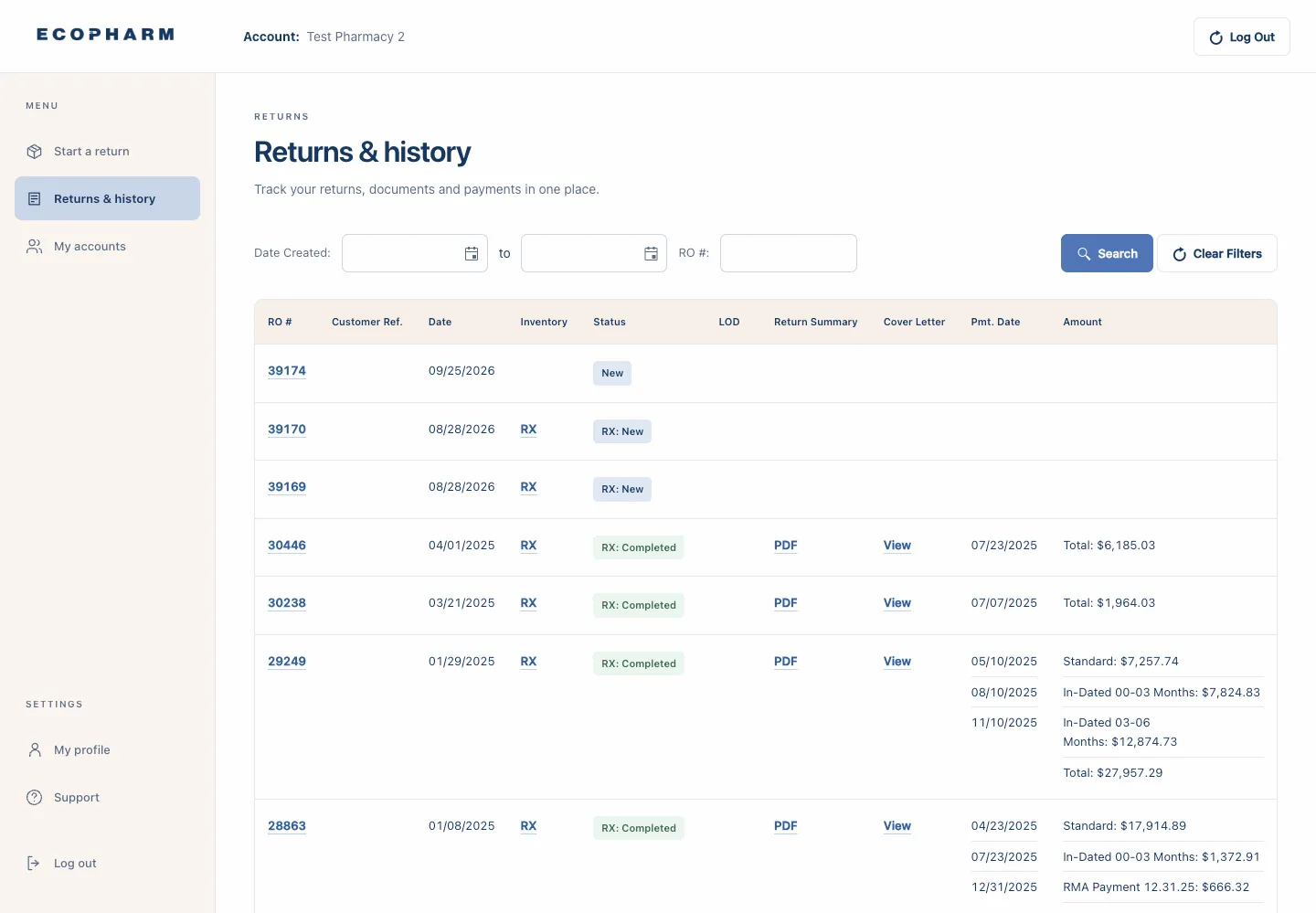
Return statements
Return summaries as PDFs and cover letters for every return.
Payments by return
Payment dates and amounts, broken down the way manufacturers pay.
Filters that scale
Search by date range or return number across the history.
Implementation
From first call to a running program
A guided path with checkpoints you can plan around. Timelines are set together during discovery.
Phase 01
Discovery
Your facilities, volumes, current vendors and what success looks like.
Phase 02
Program design
Service model per site, pickup cadence, controlled‑substance and disposal workflows.
Phase 03
Pilot
One or a few sites first, to prove the workflow before rolling it out.
Phase 04
Training & rollout
Staff onboarding, software demos and rep visits where chosen.
Phase 05
Governance reviews
Recurring reviews of the program, its results and what to adjust.
What we need from you
What does a health system need to get started?
Four things: your facility list, the licenses for each site, a stakeholder map and your current vendors.
Our customer service team verifies your credentials quickly, then sets up training and a demo of the software for your staff.
Facility list
Every location in scope, with its type.
Licenses
State Licenses and DEA certifications per site.
Stakeholder map
Who leads pharmacy, finance and compliance.
Current vendors
Existing partners and contract dates.

Compliance
A licensed partner your auditors will recognize


Program assessment
Let's map your network
Tell us how many facilities you run and what you need, and we'll come back with a program design for your review.